
Guided
Learners begin with clear structure, examples and boundaries.
They are introduced to ideas step by step and given enough support to understand what they are being asked to do before making more decisions for themselves.
Loading...
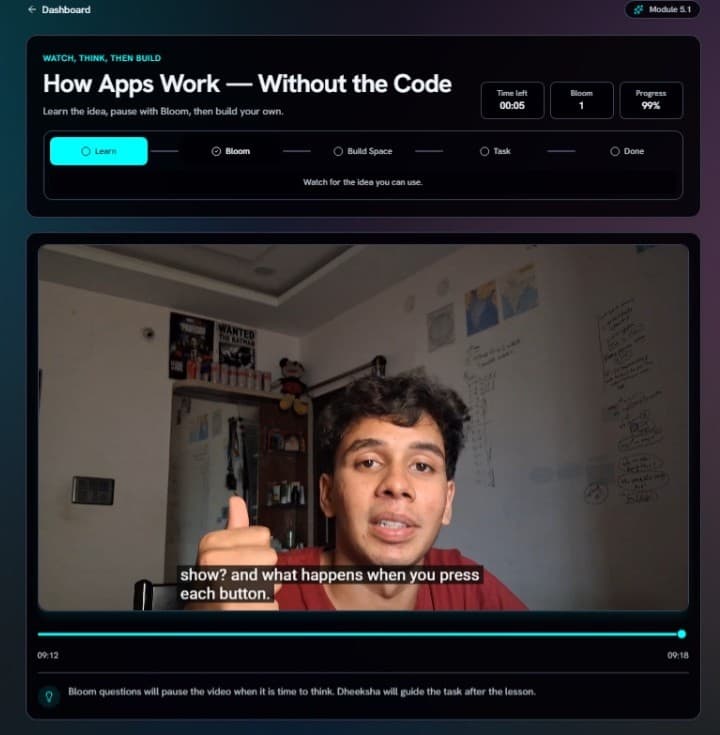
UpgrAIed gives learners structure first, then gradually gives them more room to make decisions for themselves.
As their judgement develops, they move from following clear guidance to making choices about how they approach a task, and eventually to applying what they have learned in new situations.
Guided → Choice → Transfer
The aim is not independence for its own sake.
It is to help learners become more capable of deciding what to do when AI is available.
Learners begin with clear structure, examples and boundaries.
They are introduced to ideas step by step and given enough support to understand what they are being asked to do before making more decisions for themselves.
As learners become more confident, they are given more room to choose how they approach the work.
They begin making decisions about what to try, what to question, what to change and how to use AI or other tools where appropriate.
Later, learners apply what they have learned in new contexts rather than simply repeating the same process.
They are expected to adapt their thinking, make more independent decisions and use what they know to create, solve or improve something in a different situation.
Guidance reduces as judgement grows.
Each UpgrAIed module follows a familiar learning rhythm so students know what kind of thinking is expected, even as the subject matter and level of independence change.
Learn → Think → Build → Reflect
Understand the idea and see how it works.
This gives the learner enough context to engage with the task rather than jumping straight into an AI tool or finished output.
Question it, respond and form your own judgement.
The learner is asked to consider the idea, make choices and bring their own reasoning into the activity.
Use what you've learned to create, solve or improve something.
The build may be a response, plan, design, presentation, solution, workflow, automation or other output appropriate to the module.
Look back at what you did, what changed and what you would do differently.
Reflection helps the learner notice their own decisions and how their thinking developed through the activity.
The rhythm stays familiar. What changes across the programme is the complexity of the work and how much judgement the learner is expected to exercise.
A finished project shows what a learner made. UpgrAIed also makes space for the thinking that happened along the way.
The project, response, design, solution or other output they created.
The decisions, questions, reflections and changes that shaped the work.
The evidence they provide to show what they completed and how they approached it.
These three views matter because the final artifact is only one part of the learning journey.
A learner may arrive at a strong result after questioning an AI output, changing direction, rejecting an idea, testing something that failed, or making a better decision after reflection. Those moments are part of the learning too.
UpgrAIed therefore looks for more than finished work. It creates structured opportunities for learners to make their judgement visible through responses, submissions and reflection across the programme.
The finished project is the visible part. The thinking behind it is the real portfolio.
The learning model isn't separate from the product. Learners experience it as they move through UpgrAIed.
Before the learning begins, UpgrAIed asks what the learner already thinks, in their own words.
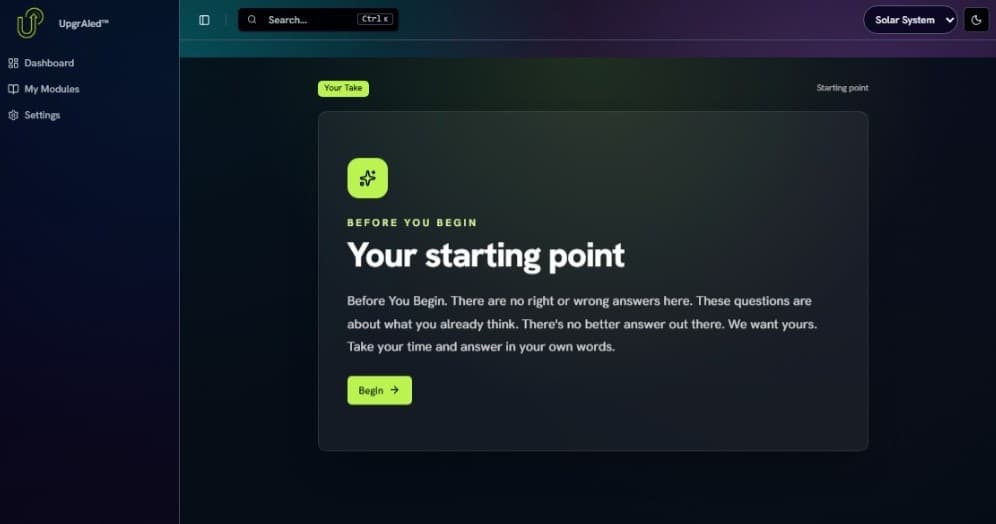
Learners begin with the idea, with Bloom creating points in the learning experience where they pause, respond and bring their own thinking into the lesson.
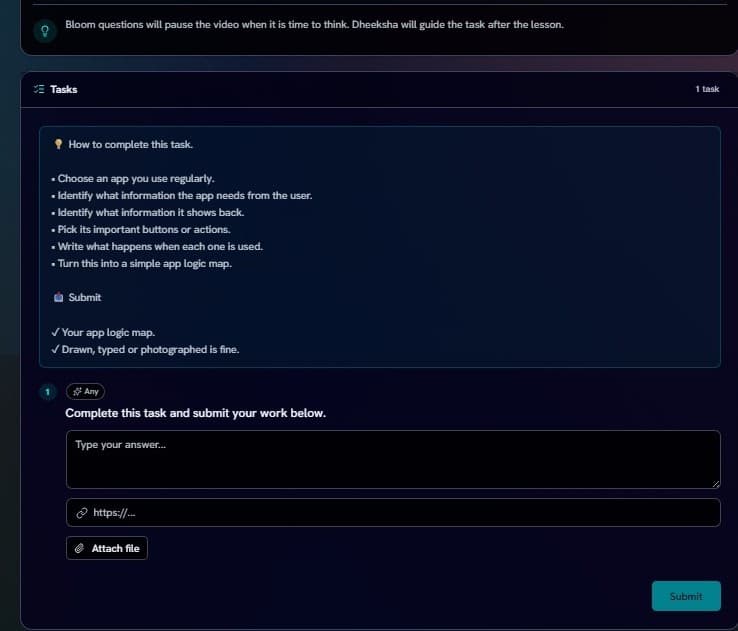
Learning moves toward something the learner has to do.
Tasks ask learners to apply what they have learned, create or solve something, and submit evidence of their work.
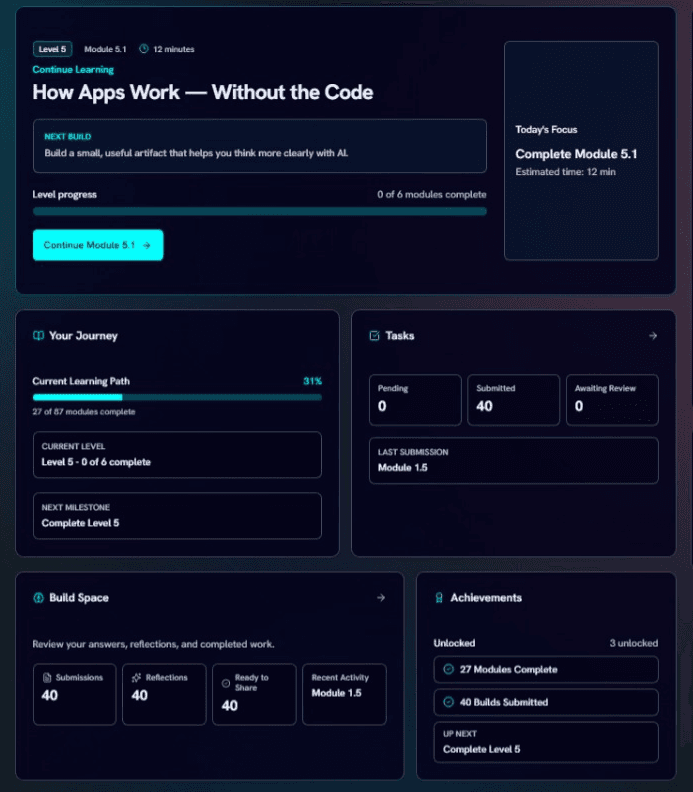
Progress does not disappear when a module ends.
The learner can return to their journey, submissions, reflections, builds, milestones and achievements as they continue through the programme.
UpgrAIed is self-paced. Learners can move through the programme in their own time and revisit learning when they need to.
Human mentor support is available at defined points in the learning journey to add guidance, context and perspective. It is not continuous tutoring, and it is not there to complete the learner's work.
Parents, guardians and teachers can support the learner too, by asking questions, discussing decisions and helping with access or permission where needed.
A parent, grandparent, guardian or teacher who becomes a Learning Partner has their own learning journey. They are not there to monitor the learner or do the work for them.
The learner thinks, responds and builds for themselves. The Learning Partner does the same in their own journey.
The learner still owns the work.
Learn independently. Think together. Build differently.
For parents: Learn more about the parent's role and learning alongside your child →
UpgrAIed teaches learners to use AI while keeping their own judgement involved.
The programme moves from guided learning toward more independent judgement, creation and building across a structured 14-level journey.
See how UpgrAIed works before deciding whether to continue with the full programme.