
Think
Begin with an idea, question, plan or judgement of your own.
Loading...
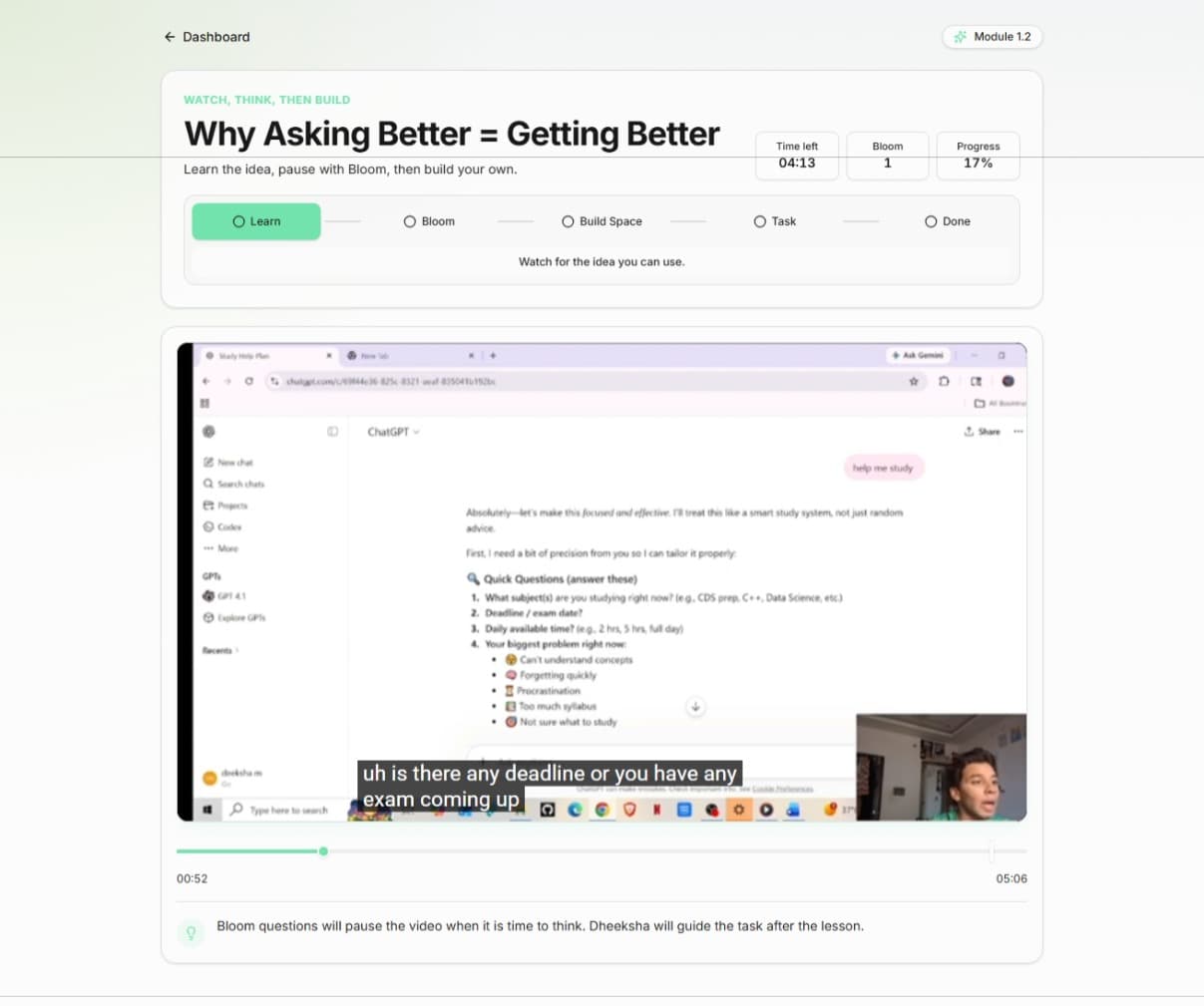
UpgrAIed teaches students how to work with AI without handing their thinking over to it.
Across the programme, learners begin with their own thinking, use AI where appropriate, question and verify what it produces, make their own decisions, and explain or demonstrate the judgement behind what they build.
This approach applies across all 87 learner-reachable modules in Levels 1 to 14.
Not to complete Level 1.
Learners in Level 1 can achieve the learning objectives without independently creating or using an external AI account.
Where an AI or other digital tool is available as an optional part of an activity, its use depends on the provider's age requirements and any permission needed.
If a learner cannot use a particular external tool, UpgrAIed provides an account-independent route so they can still complete the learning.
The goal is not to make access to a particular AI platform a requirement.
The goal is to help the learner begin understanding how to think, question and make decisions when AI is part of the process.
AI can help a learner explore, create, compare, solve and build. But using AI well involves more than getting an output.
Across UpgrAIed, students learn to keep their own judgement involved.
Begin with an idea, question, plan or judgement of your own.
Bring in AI where it can genuinely help, to explore possibilities, develop something further, test an approach or support a build.
Examine what AI produces rather than automatically accepting it.
When correctness matters, decide what needs checking and use appropriate evidence, sources or testing to verify it.
Choose what to accept, change or reject.
The final decision remains with the learner.
Turn the thinking into something: a response, decision, design, solution, project or working build, and be able to explain the judgement behind it.
AI can contribute to the process. The learner remains responsible for what they decide and build.
A polished AI output on its own does not show us how a learner thinks.
As students progress through UpgrAIed, they are increasingly asked to demonstrate the judgement behind what they create.
That can include showing:
Not every activity asks every question. The purpose is not to make learners document every interaction with AI.
The purpose is to make their thinking increasingly visible alongside what they build.
UpgrAIed also creates structured opportunities for learners to reflect on their own judgement through Your Take, where they respond to questions connected to their learning as they progress through the programme.
The finished project is the visible part. The thinking behind it is the real portfolio.
If AI doesn't need the personal information for the learning task, don't give it the information.
Where possible, students are encouraged to use:
Fictional · Sample · Generic · Appropriately anonymised information
Students should not unnecessarily put information such as the following into external AI or digital tools:
Sometimes a learning activity may involve information from another person, such as feedback or testing. Where appropriate, that information should be anonymised before it is used with AI.
The principle is simple: use the information the learning requires, not everything that is available.
Learning with AI does not require unnecessary exposure.
Students do not have to publish their work publicly to complete UpgrAIed.
Where sharing work outside UpgrAIed could add value, it is optional and should only happen when appropriate.
Students are not required to create LinkedIn, Fiverr or similar public accounts to complete the programme.
Learning should not depend on a child having a public profile.
Students do not need to contact strangers, prospective clients or businesses to demonstrate what they have learned.
Where feedback or real-world testing is useful, activities can involve appropriate and trusted participants instead.
Students can learn about value, offers, pricing and commercial judgement without making or receiving real payments.
Commercial understanding can be developed through planning, comparison, simulation, testing and explanation.
The aim is real-world learning without making unnecessary real-world exposure a condition of learning.
Real-world learning can include building with AI agents and automation.
When students explore these systems, they learn to think about more than whether an automation works. They are also asked to consider what it should be allowed to do, what information it should use, what could go wrong, and when a person should remain involved.
Activities use appropriate boundaries such as:
Students are not required to deploy uncontrolled autonomous agents into the real world to complete UpgrAIed.
The aim is to learn how automation can act, and how humans decide where its boundaries should be.
Adults can help with permission, access, safety, discussion and real-world context when needed.
They can ask questions, challenge assumptions and help a learner think through a decision.
But they are not there to do the learner's work.
A Learning Partner is not a monitoring account.
A parent, grandparent, guardian or teacher who becomes a Learning Partner has their own learning journey. They can discover and question AI alongside the student, then bring their different perspectives together through discussion.
The learner still thinks, responds and builds for themselves. The Learning Partner does the same in their own journey.
Learn independently. Think together. Build differently.
UpgrAIed records information needed to provide and maintain the learner's learning journey.
Depending on how the learner uses the programme, this can include:
UpgrAIed may also maintain operational, security and compliance records needed to run and protect the service.
The principle behind this is straightforward:
UpgrAIed collects and retains information for a defined purpose, not simply because it might be useful later.
When a learner account is hard-deleted, UpgrAIed removes the learner's profile, progress, responses, submissions and learner-owned files from its active systems.
Some information may need to be retained for legal, security, payment, accounting or compliance purposes. Where that happens, the information retained should be limited to what that purpose requires.
Keeping a required financial or compliance record does not mean keeping the learner's unrelated learning work.
UpgrAIed also uses external service providers to operate parts of the service. Their documented backup or deletion processes may mean residual copies remain temporarily after information has been removed from UpgrAIed's active systems.
UpgrAIed keeps identifiable learning information while it is needed to provide and maintain the learner's learning journey.
There is currently no automatic deletion simply because a learner has been inactive.
UpgrAIed has not yet set a long-term inactivity period after which a learner's account and learning history will automatically be deleted. Until that policy is defined, inactivity alone does not trigger deletion.
Families wishing to request deletion of a learner's account and data can contact UpgrAIed directly.
Where information has been genuinely anonymised so that it can no longer be attributed to an individual learner, that anonymised information may be retained separately.
UpgrAIed's Student AI Use Standard applies across all 87 learner-reachable modules in Levels 1 to 14.
New or materially changed modules must meet the same standard before becoming learner-reachable.
That means the principles described on this page are not separate safety advice added around the curriculum. They are part of how UpgrAIed is designed to teach students to work with AI.
HI First. AI Always.
Think · Question · Verify · Build.